
Don’t Just do Something, Sit There
Is immolation positive action?

In June of 1963, in the middle of a busy intersection in downtown Saigon, Thich Quang Duc, a Buddhist Monk, immolated himself as a statement on the policies of the Catholic Diem government of South Vietnam. I was but a wee lad of 2 at the time, so I’m not sure if I saw it in 1963, but it is one of my most powerful memories/associations of the Vietnam War and a very early exposure to Buddhism.
Photographer Malcolm Browne received the Pulitzer Prize for the pictures. When asked, “How did you feel?”, Browne responded, “The main thing on my mind was getting the pictures out. I realized this is something of unusual importance and that I’d have to get them to the AP in one of its far flung octopus tentacles as soon as possible.” 1
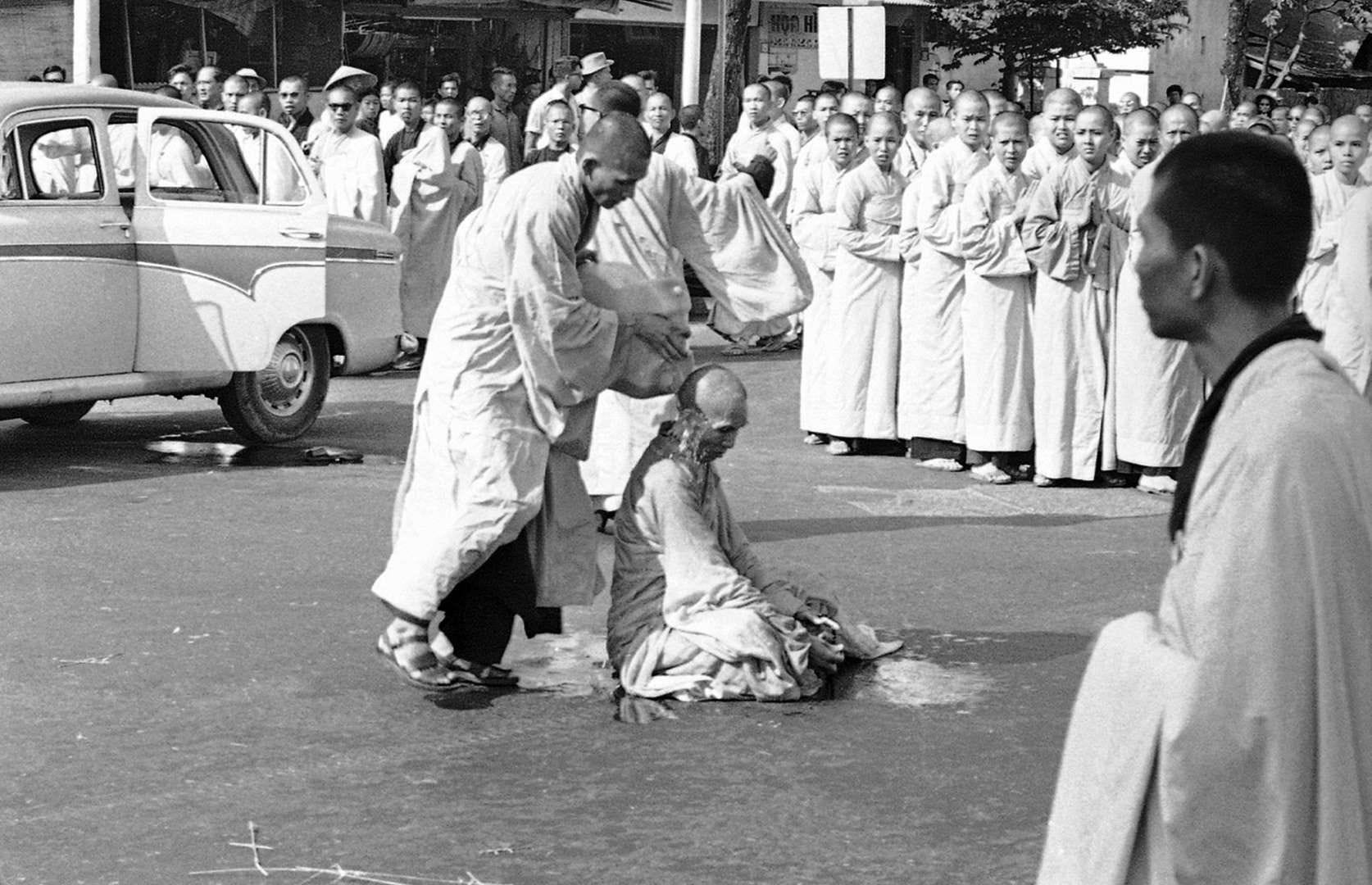
Figure 1 - Moments Before
Yeah, not going to post it here but President Kennedy said, “No news picture in history has generated so much emotion around the world as that one.” No shit.
Browne’s response is what is wrong with almost all media, especially social media (BTW, I self-immolated my reddit, facebook, and linkedin accounts last night). All this media is ostensibly touted to bring connection, but it is actually, literally, designed to generate strife and discord, and quickly divides people. Why is it so decisive? Because it is ultimately selfish. I will return to this in a moment.
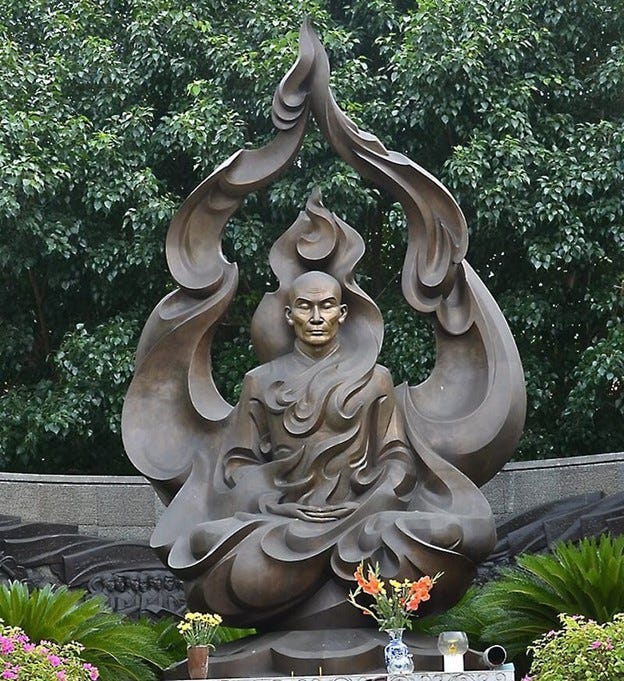
Figure 2 A bit after
Thich Nhat Hanh (Thay) wrote in June of 1965 to Rev. Martin Luther King letter titled “In Search of the Enemy of Man.” In that, he argued that it was not suicide because of the “intent” of Thich Quang Duc.
This is not suicide. Suicide is an act of self-destruction, having as causes the following:
lack of courage to live and to cope with difficulties
defeat by life and loss of all hope
desire for non-existence (abhava)
This self-destruction is considered by Buddhism as one of the most serious crimes. The monk who burns himself has lost neither courage nor hope, nor does he desire non-existence. On the contrary, he is very courageous and hopeful and aspires for something good in the future. He does not think that he is destroying himself; he believes in the good fruition of his act of self-sacrifice for the sake of others. Like the Buddha in one of his former lives — as told in a story of Jataka — who gave himself to a hungry lion which was about to devour her own cubs, the monk believes he is practicing the doctrine of highest compassion by sacrificing himself in order to call the attention of, and to seek help from, the people of the world.
A few weeks ago (February 2024), US Air Force Airman Aaron Bushnell performed the same act in protest of the Israel-Gaza conflict.
“I am an active duty member of the United States Air Force. And I will no longer be complicit to genocide. I am about to engage in an extreme act of protest. But compared to what people have been experiencing in Palestine at the hands of their colonizers—it’s not extreme at all.”2
I will not attempt to debate Buddhist ethics with Thay. Buddhism is pretty consistent in that suicide is a “bad thing ™.” I will only say that I read somewhere (and I can’t find the reference) that it depends on the pure intent at the actual moment of the act. Who can truly know if Aaron Bushnell or Thich Quang Duc was an Arhat when temperature became incompatible with life? Suicide, in most cases, is an expression of rage against the world (machine???) for not being as one wants and not accepting or forgiving it for the way it is. Anne Lamott says "Not forgiving is like drinking rat poison and then waiting for the rat to die.”3 It is inherently selfish to take your ball and go home.
Consuming alcohol, drugs, and escapist entertainment, esp. social media, are also selfish acts. It is a declaration that one’s pleasure, time, health, or opinion deserves to be elevated above another’s. The fifth Buddhist precept says, “Refrain from Intoxicants” because they can cause “carelessness” – again, “no shit”!
“The man who drinks from this is prey to every danger because he loses his senses. One might burn to death in one’s bed, stumble into a pack of jackals, drown in a puddle, become reduced to bondage or penury — there is no misfortune that drinking this may not lead to.”4
Any addiction is a form of selfish violence, just like suicide – even occasionally, they are synonymous. Social media has destroyed the body politic. Our choices are Biden and Trump? Seriously? (not) It is making our children miserable and suicidal. No, there was not social media in 1963 but there was the Associated Press. Aaron Bushnell, as many others, posted his final words on Facebook. Where does a US Airman get the idea to self-immolate instead of fulfill an oath to god, country, and ultimately the world?
Allowing oneself to be polarized by words is to forget that the world is infinitely interconnected. How many people were needed to bring that bite of food to your fork this morning for breakfast? How about the water for your toilette? The plastic, metals, minerals, and electricity for your computer to read this? Then again, I’m trying to persuade you that I have something to say and that your time is worth you reading this. I commit to these gates for my work here:
Before You Speak, Let Your Words Pass Through Three Gates:
Is it true?
Is it necessary?
Is it kind? - Rumi
Apply these gates to all your consumption—you will know more peace. Don’t deny the world your ability to discern the truth that grows kindness and compassion.
Ghasso
https://time.com/3791176/malcolm-browne-the-story-behind-the-burning-monk/
Thich Nhat Hanh - In Search of the Enemy of Man https://plumvillage.org/about/thich-nhat-hanh/letters/in-search-of-the-enemy-of-man
“Not forgiving is like drinking rat poison and then waiting for the rat to die.”
― Anne Lamott, Traveling Mercies: Some Thoughts on Faith